
Idaho Voters to Decide Who Controls Future Marijuana Policy
10/23/2026
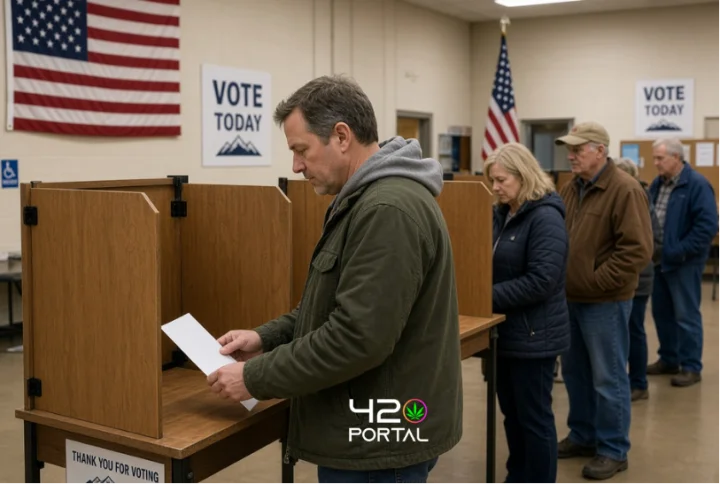
Idaho remains one of the few states where marijuana stays fully illegal, with no medical program and no path for adults to possess or grow it under state law. On November 3, voters will decide whether to lock that reality in place by giving the Legislature sole authority over any future change. House Joint Resolution 4, passed by lawmakers in 2025, would amend the constitution so that only the Legislature can legalize the growing, selling, possessing, or using of marijuana. A yes vote ends citizens' ability to place a marijuana measure on the ballot. A no vote leaves the current system unchanged.
Right now, either route remains open. The Legislature can pass a bill, or citizens can gather signatures for an initiative. Multiple groups have tried the second path over the past decade, including medical marijuana proposals in several election cycles and a 2026 effort by the Natural Medicine Alliance of Idaho that collected well over 100,000 signatures before falling short of the valid-signature and district-distribution requirements. None have reached the ballot. Neighboring Washington, Oregon, Montana, and Nevada all legalized through voter initiatives rather than legislative action.
Sen. Scott Grow, a Republican from Eagle who co-sponsored the measure, has argued that the change protects Idaho from well-funded campaigns by groups that stand to profit from legalization. He notes that the Legislature already holds the power to act and that residents can still speak at public hearings and contact their elected representatives. Nearly all Republicans in both chambers supported HJR 4 when it advanced, while Democrats opposed it. The final votes were 58-10 in the House and 29-6 in the Senate.
Constitutional scholar David Adler, president of the Alturas Institute in Idaho Falls, has countered that approval would mean voters permanently hand over their own authority on the question. He points out that ballot initiatives have served as a direct check in Idaho for decades and that no one can predict what future medical or policy developments might look like. Polling has consistently shown majority support among Idahoans for allowing medical marijuana, including one recent survey that found roughly 83 percent in favor of some form of medical access.
The amendment does not legalize or further restrict marijuana on its own. It only decides who gets to make that call going forward. With past citizen efforts having repeatedly missed the signature threshold and the Legislature showing little interest in expanding access, the November vote will determine whether that dynamic continues indefinitely.
Reference
